Home / Technology / CortexDD
Proprietary Technology · Holding Advisory LLC

CortexDD
Intelligent
Diligence Engine

A neural memory architecture that ingests, organizes, and reasons across every dimension of a diligence corpus — transforming unstructured data into structured institutional intelligence.

Vector Embedding Semantic Clustering FTS5 Full-Text Search BERTopic Adaptive Reasoning Prompt Studio
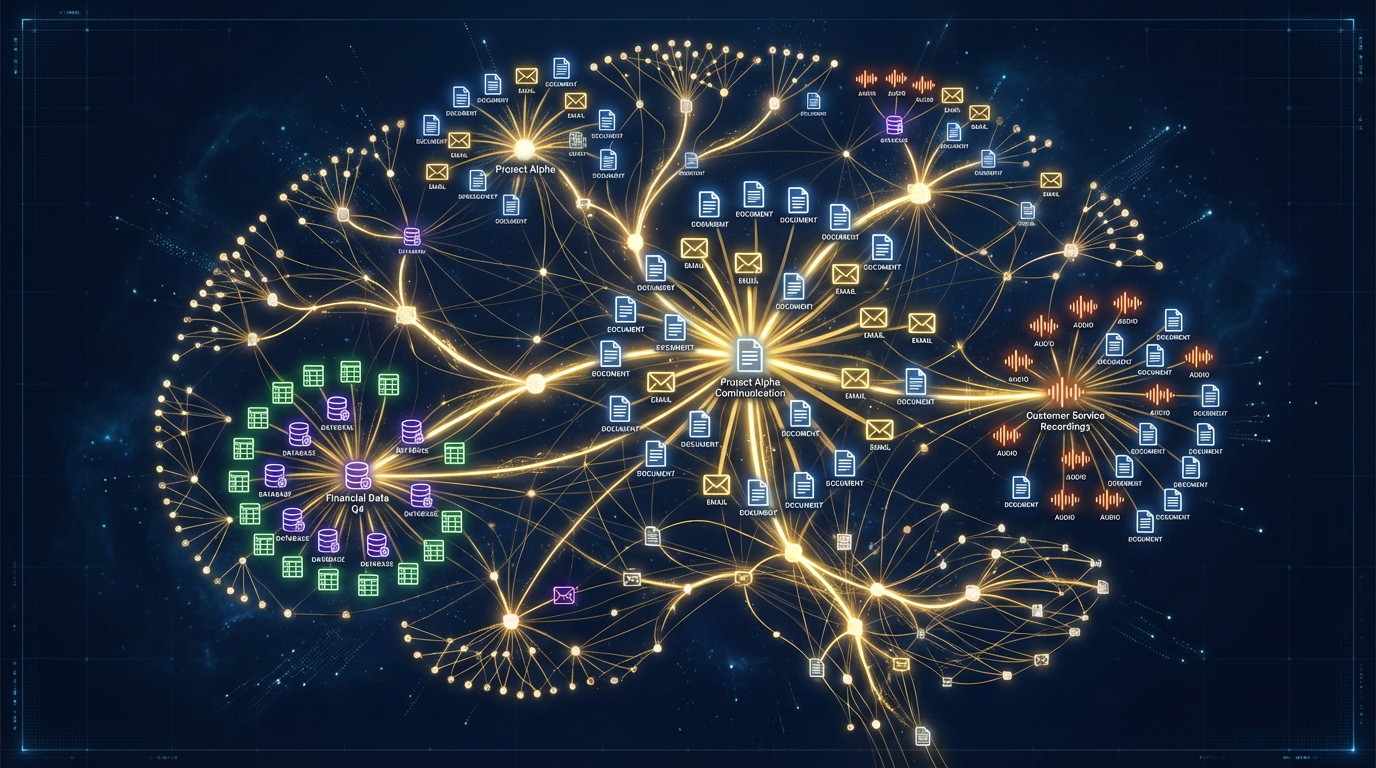
CortexDD neural memory graph

Neural memory graph — cross-source entity linkage across a live diligence corpus

Source Types Ingested
High-Dim Vector Embedding Space
5 Pipeline Stages
360° Diligence Coverage

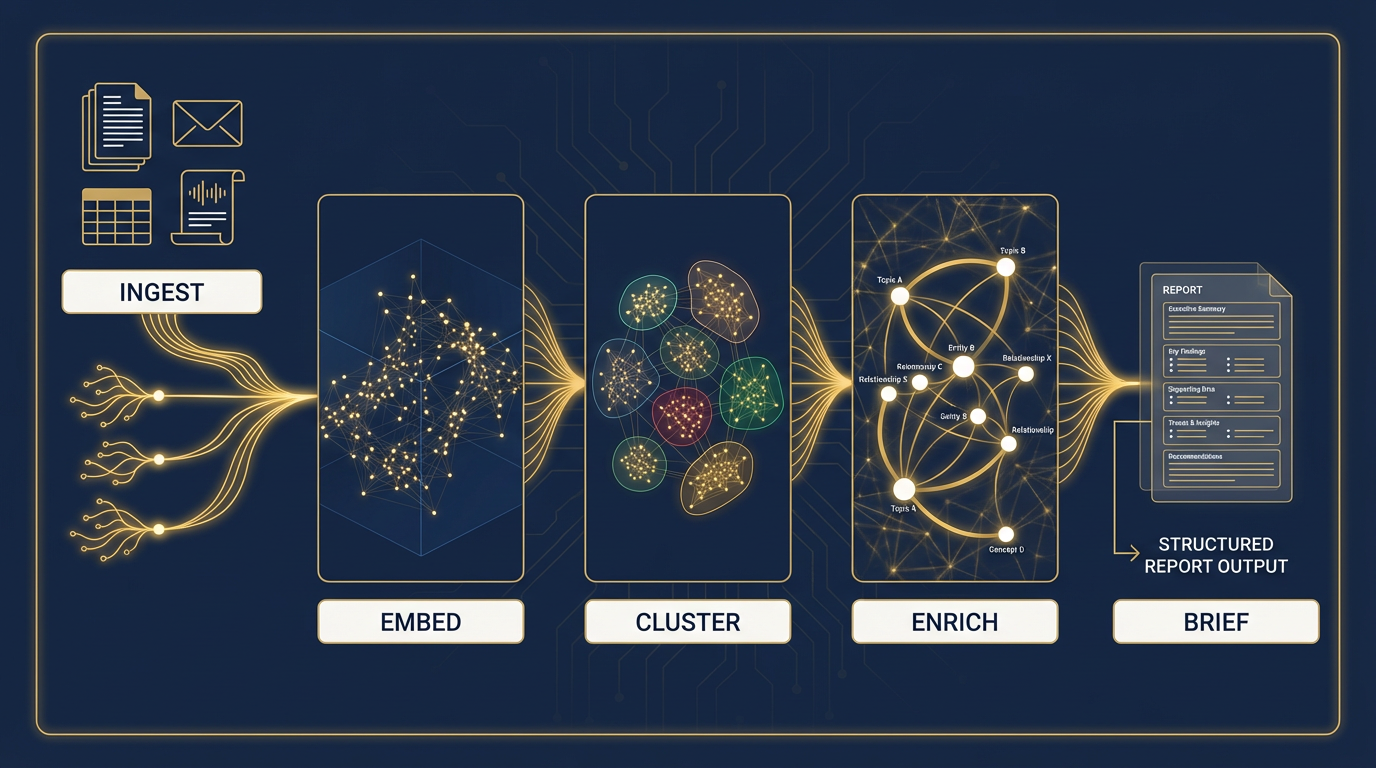
The Five-Stage Intelligence Pipeline

CortexDD processes every element of a diligence corpus through a sequential enrichment pipeline — from raw heterogeneous input to a fully structured, queryable intelligence layer ready for brief production.

CortexDD five-stage pipeline
01 Ingest

Any source format ingested — PDFs, spreadsheets, email threads, call transcripts, CRM exports, system data — normalized into a unified document corpus.

Universal Parser · Format Normalization
02 Embed

Each document chunk is converted into a high-dimensional vector representation, capturing semantic meaning beyond keyword matching — enabling contextual retrieval across the entire corpus.

Vector Embeddings · Semantic Space
03 Cluster

BERTopic applies UMAP dimensionality reduction followed by HDBSCAN density clustering and c-TF-IDF labeling — surfacing latent topic structure invisible to manual review.

BERTopic · UMAP · HDBSCAN · c-TF-IDF
04 Enrich

FTS5 full-text indexing overlays structured search on the semantic layer. Entities, relationships, anomalies, and cross-document signals are extracted and linked into a navigable knowledge graph.

FTS5 · Entity Extraction · Knowledge Graph
05 Brief

Adaptive reasoning logic synthesizes the enriched corpus into structured diligence output across all dimensions — via pre-configured templates or custom Prompt Studio queries.

Adaptive Reasoning · Prompt Studio

Every Document Becomes a Point in Meaning-Space

Traditional diligence relies on sequential human reading — one document at a time, one analyst at a time. CortexDD converts every chunk of every source into a high-dimensional vector that encodes its semantic content, not just its keywords.

The result: a complete semantic map of the entire corpus. Documents from entirely different formats — a CFO email, a customer contract clause, a revenue bridge spreadsheet — that carry the same underlying meaning are positioned proximate in vector space, enabling retrieval that transcends source, format, or terminology.

  • Cross-format semantic equivalence detection
  • Contextual retrieval without keyword dependency
  • Anomaly detection via vector distance outliers
  • Theme evolution tracking across document chronology
  • Contradiction surfacing across distributed sources
Vector space embedding visualization

High-dimensional semantic projection — raw data organizing into diligence topic clusters

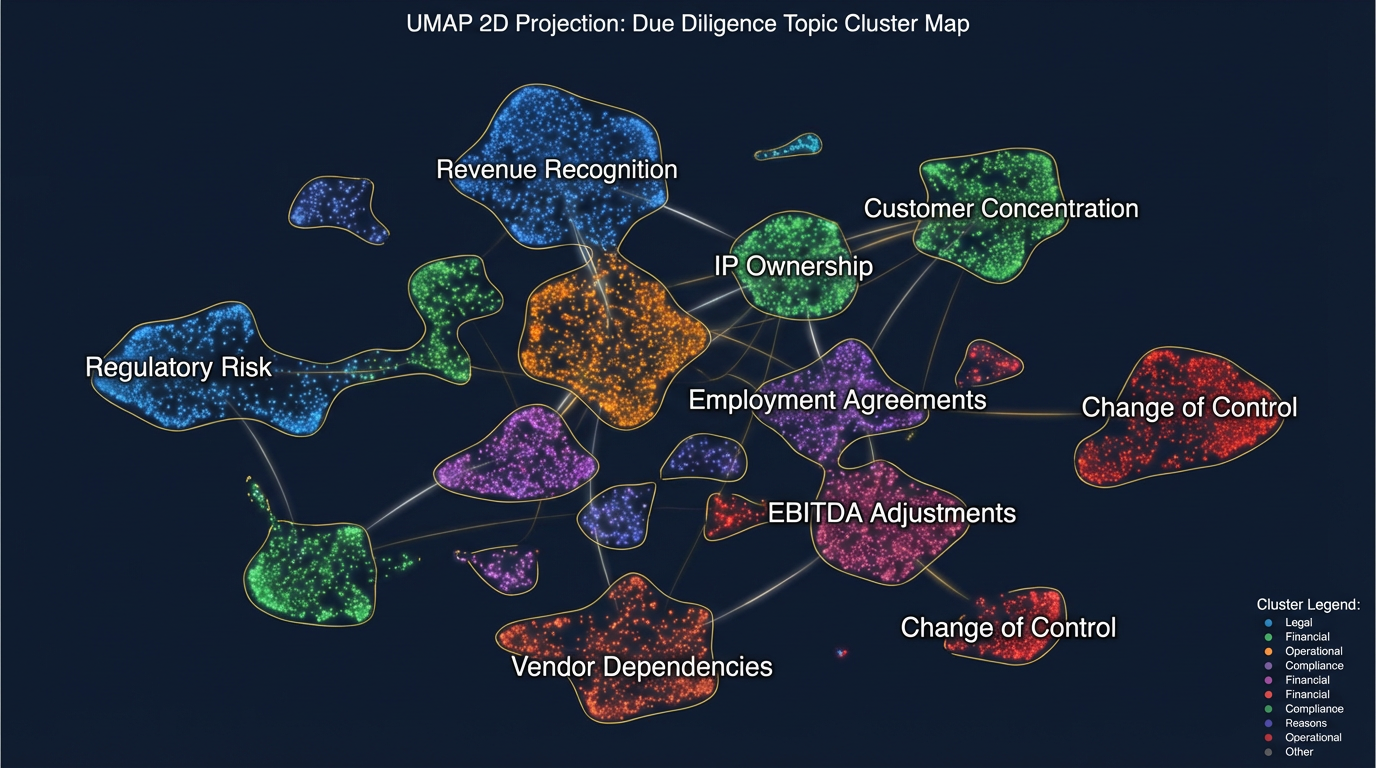
Latent Structure, Made Visible

BERTopic's three-stage process — UMAP projection, HDBSCAN clustering, c-TF-IDF labeling — reveals the thematic architecture of a corpus that no human reviewer would reconstruct manually. Topics emerge from the data itself, not from a pre-defined taxonomy.

BERTopic UMAP cluster map

Three Layers of Topic Intelligence

  • UMAP — reduces high-dimensional embeddings to a navigable 2D topology while preserving local and global semantic structure
  • HDBSCAN — density-based clustering that identifies topic boundaries without requiring a predefined cluster count — noise-tolerant and scale-adaptive
  • c-TF-IDF — class-based term frequency weighting that generates human-readable topic labels from cluster content, not from hand-coded categories

What This Surfaces

  • Undisclosed related-party relationships across email and contract layers
  • Revenue recognition inconsistencies across financial models and customer contracts
  • Management narrative divergence between CIM representations and operational data
  • Concentrated dependency risks scattered across multiple source documents
  • Regulatory exposure themes embedded across legal and operational materials

The Neural Ledger — Cross-Source Memory at Corpus Scale

Human memory does not file information by document type. It organizes by meaning, relationship, and context — instantly surfacing what is relevant regardless of where it was originally stored. CortexDD's enrichment layer replicates this architecture.

FTS5 full-text indexing overlays structured retrieval on the semantic foundation. Entities — companies, individuals, dates, financial figures, legal terms — are extracted and linked across the entire corpus, creating a persistent memory graph that grows denser and more connected as materials accumulate.

  • Entity resolution across naming variants and abbreviations
  • Relationship mapping: who referenced what, when, and in what context
  • Cross-document citation chains — claims traced to source evidence
  • Temporal signal tracking — how narratives shift across the data room timeline
  • Gap detection — what is present, what is absent, what should exist but doesn't
Neural memory knowledge graph

Cross-source entity linkage — documents, emails, transcripts, and data unified in one traversable graph

Prompt Studio — From Corpus to Brief

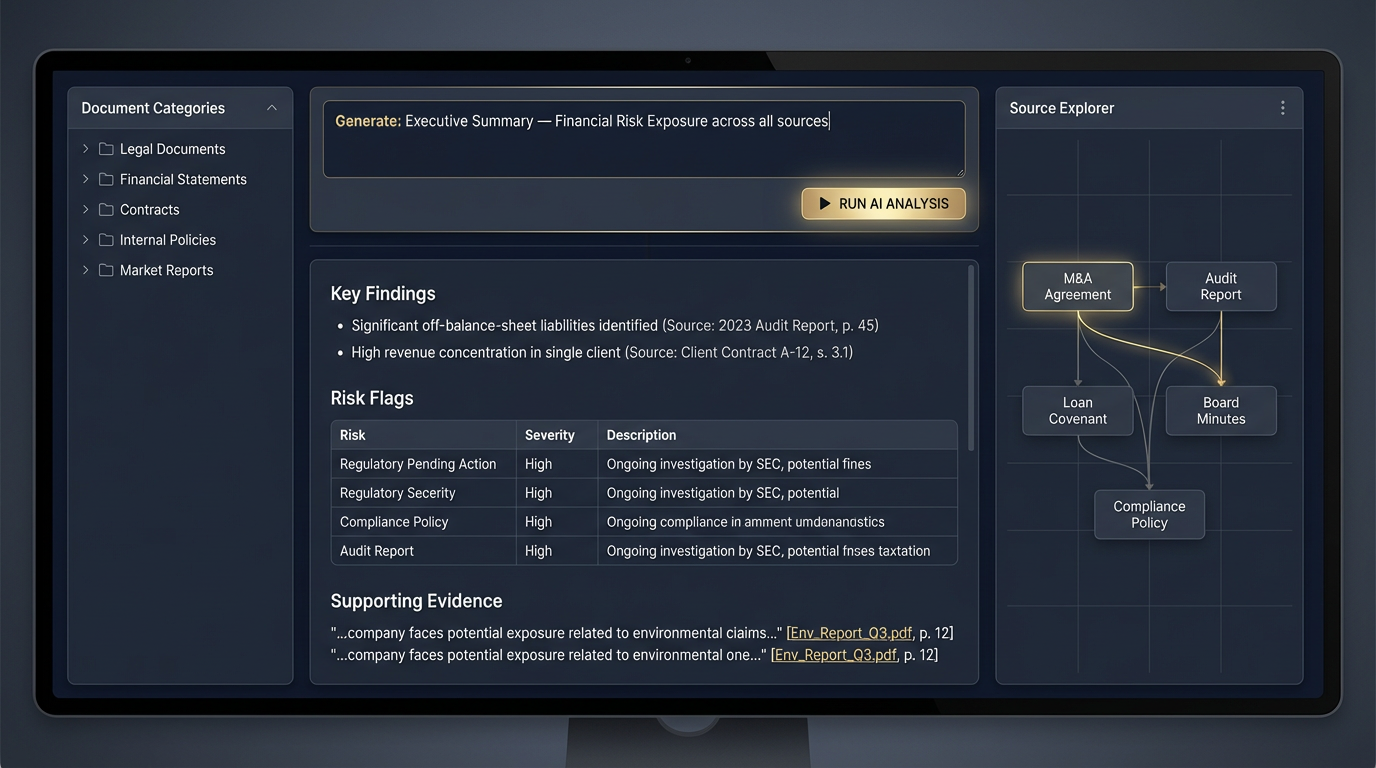
The enriched corpus becomes a fully queryable intelligence layer. Prompt Studio enables structured brief production — either through pre-configured diligence templates covering all standard dimensions, or through custom query workflows tailored to engagement-specific priorities.

Prompt Studio Interface CortexDD Prompt Studio interface
Pre-Configured DD Templates

Standard diligence dimensions — Financial, Legal, Operational, Commercial, Technology, HR, Regulatory — mapped to structured output templates. One prompt, comprehensive coverage.

Custom Query Workflows

Engagement-specific queries constructed in plain language. The adaptive reasoning layer translates intent into structured retrieval across the full vector, cluster, and entity architecture.

Evidence-Anchored Output

Every finding is traceable to its source. The brief production layer embeds citations, document references, and supporting excerpts — enabling independent verification of every conclusion.

A Fundamentally Different Execution Model

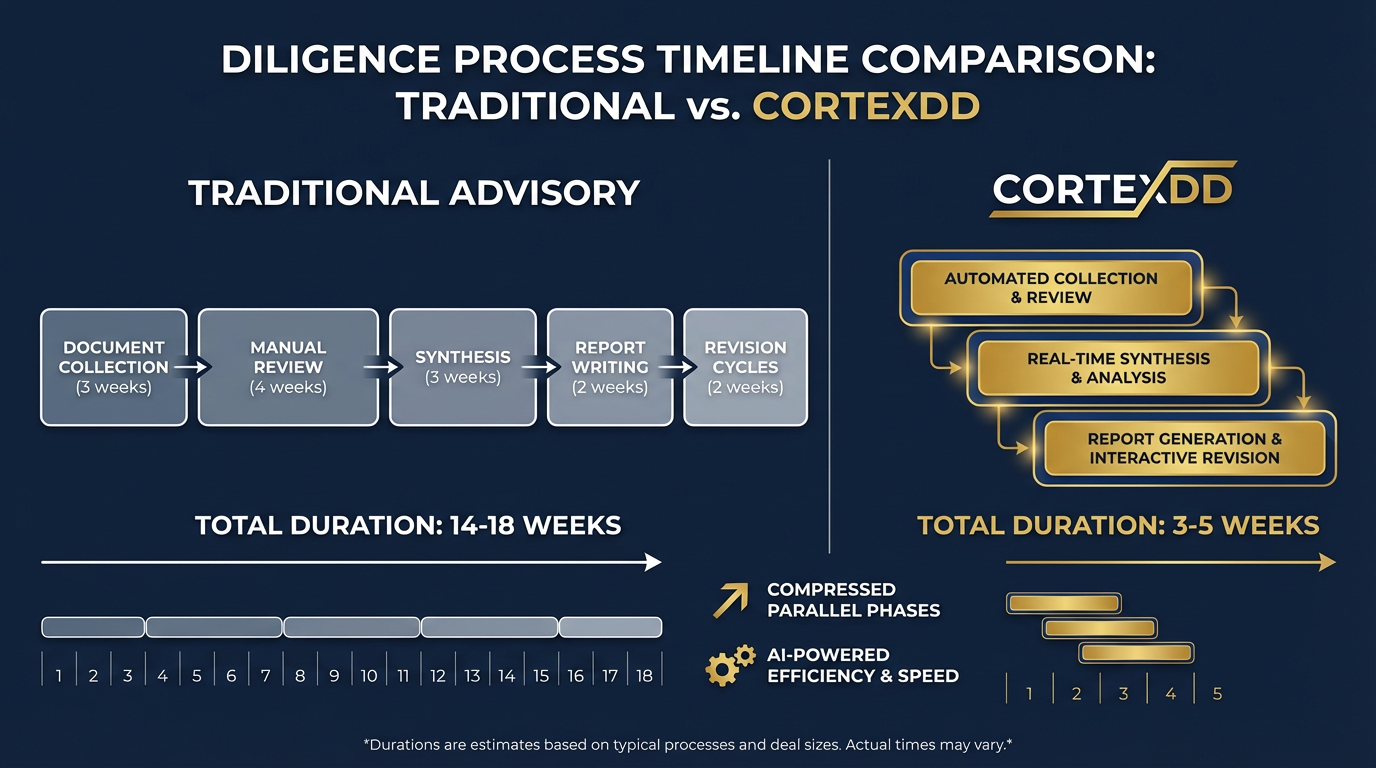
Traditional advisory diligence is a sequential, labor-intensive process — document collection precedes review, which precedes synthesis, which precedes reporting. Each phase is a bottleneck. Each handoff introduces delay and information loss.

CortexDD collapses this sequence. Ingestion, embedding, clustering, enrichment, and brief production operate in a continuous, parallel architecture. As new materials arrive they are immediately integrated — the corpus remains current, queryable, and complete throughout the engagement.

  • Parallel processing replaces sequential phase dependency
  • Continuous corpus integration — no batch review cycles
  • Real-time query against live data room as materials arrive
  • Revision cycles eliminated — output updates as inputs change
  • Engagement team scales to complexity, not to document volume
Traditional vs CortexDD diligence timeline

Traditional sequential process vs. CortexDD parallel architecture

Why This Cannot Be Replicated Off the Shelf

Management consultants and traditional advisors possess domain knowledge. They do not possess the engineering capability to build, customize, and adapt systems like CortexDD to the specific demands of live transactions.

01 Engineering Depth, Not Prompt Wrapping

CortexDD is not a GPT wrapper. It is a purpose-built pipeline combining vector search architecture, probabilistic topic modeling, full-text indexing, and adaptive reasoning logic — each component tuned specifically for financial diligence workflows.

02 Proprietary Reasoning Logic

The output layer employs structured reasoning approaches that transcend standard LLM inference — incorporating domain-specific financial and legal heuristics, contradiction detection protocols, and confidence-weighted synthesis that general models do not replicate.

03 Engagement-Adaptive Architecture

The system is engineered to be reconfigured per engagement — sector-specific vocabulary, custom entity taxonomies, deal-specific risk frameworks. It does not impose a generic template on a specific transaction. It adapts to the transaction's unique informational structure.

See CortexDD on Your Transaction

CortexDD is deployed as a core component of every Holding Advisory engagement requiring diligence support. It is not licensed or sold independently — it is the engine behind the work.

Discuss an Engagement