A pre-built ecosystem of purpose-engineered tools that connects every node of a company's financial system constellation — integrating via MCP and REST API, then applying an intelligence layer for late-binding analysis that transforms raw system data into institutional-grade decision support.
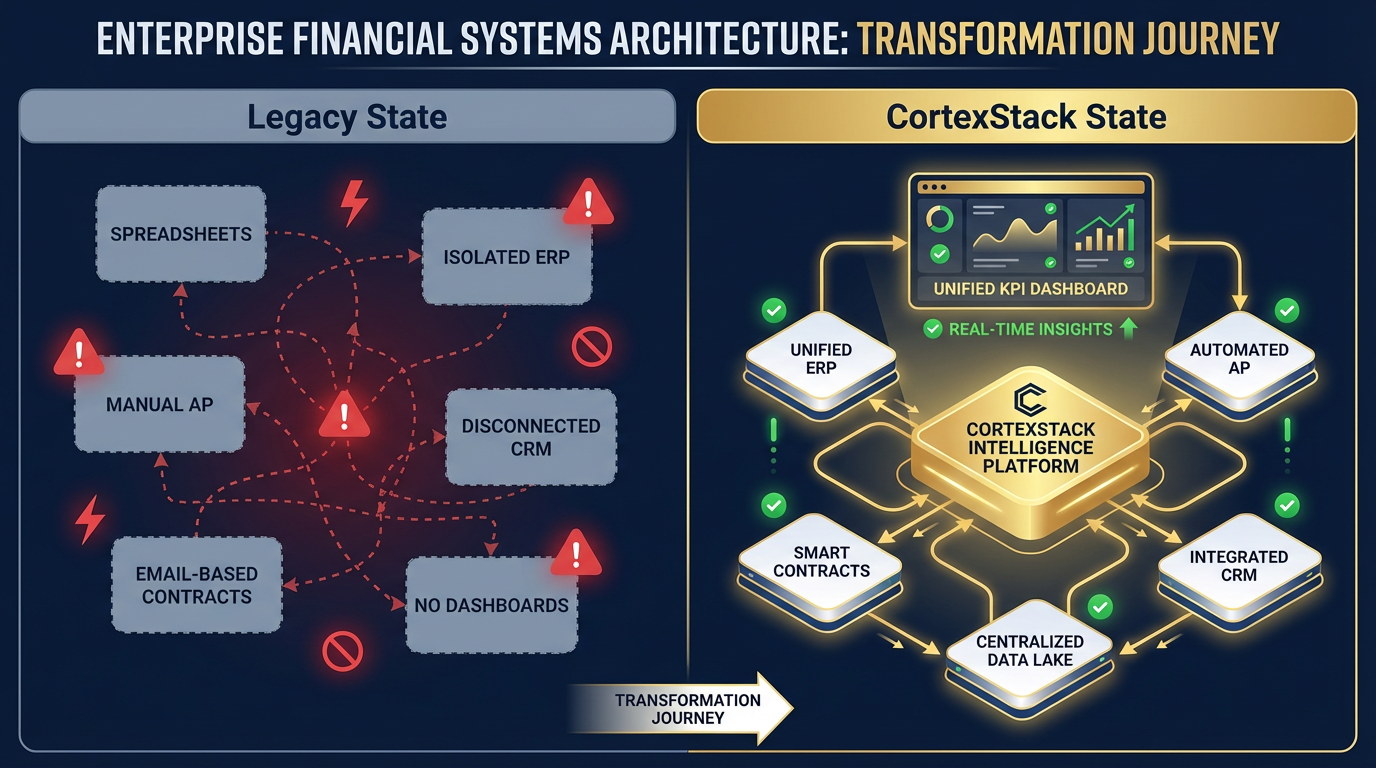
The average mid-market company operates five to twelve financial and operational systems simultaneously — an ERP for ledger and reporting, separate platforms for AP and AR, a CRM disconnected from contract management, internal communications siloed from workflow, and ancillary tools stitched together by spreadsheets and manual reconciliation.
The result is a finance function that is perpetually reactive, consuming analyst bandwidth on reconciliation rather than analysis, producing management reporting assembled by hand, and operating with no real-time visibility into KPIs that actually drive enterprise value.
Legacy disconnected state vs. CortexStack unified intelligence architecture
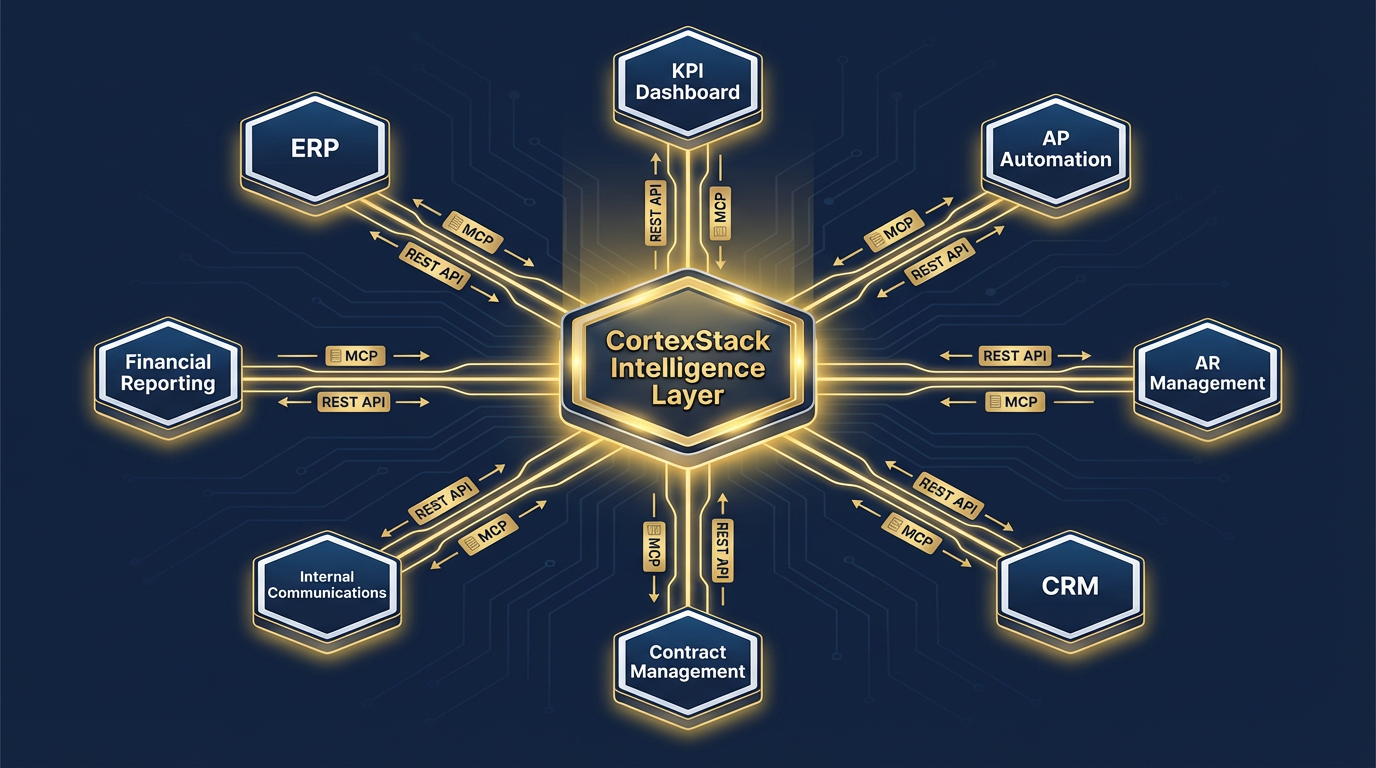
CortexStack does not replace your systems. It creates a structured data integration layer across every platform in your constellation — then applies intelligence at the output layer. This is the separation of concerns that makes late-binding AI analysis possible.
Every system in the constellation — whether an enterprise ERP, a point-of-sale platform, a CRM, or an internal communications tool — exposes its data through either the Model Context Protocol or a REST API. CortexStack connects to these interfaces with pre-built adapters, each carrying a defined schema and structured field mapping.
The result is a canonical data layer that represents the full financial and operational state of the business in a unified, query-able structure. No custom middleware. No brittle point-to-point connections. The integration is standardized and reproducible.
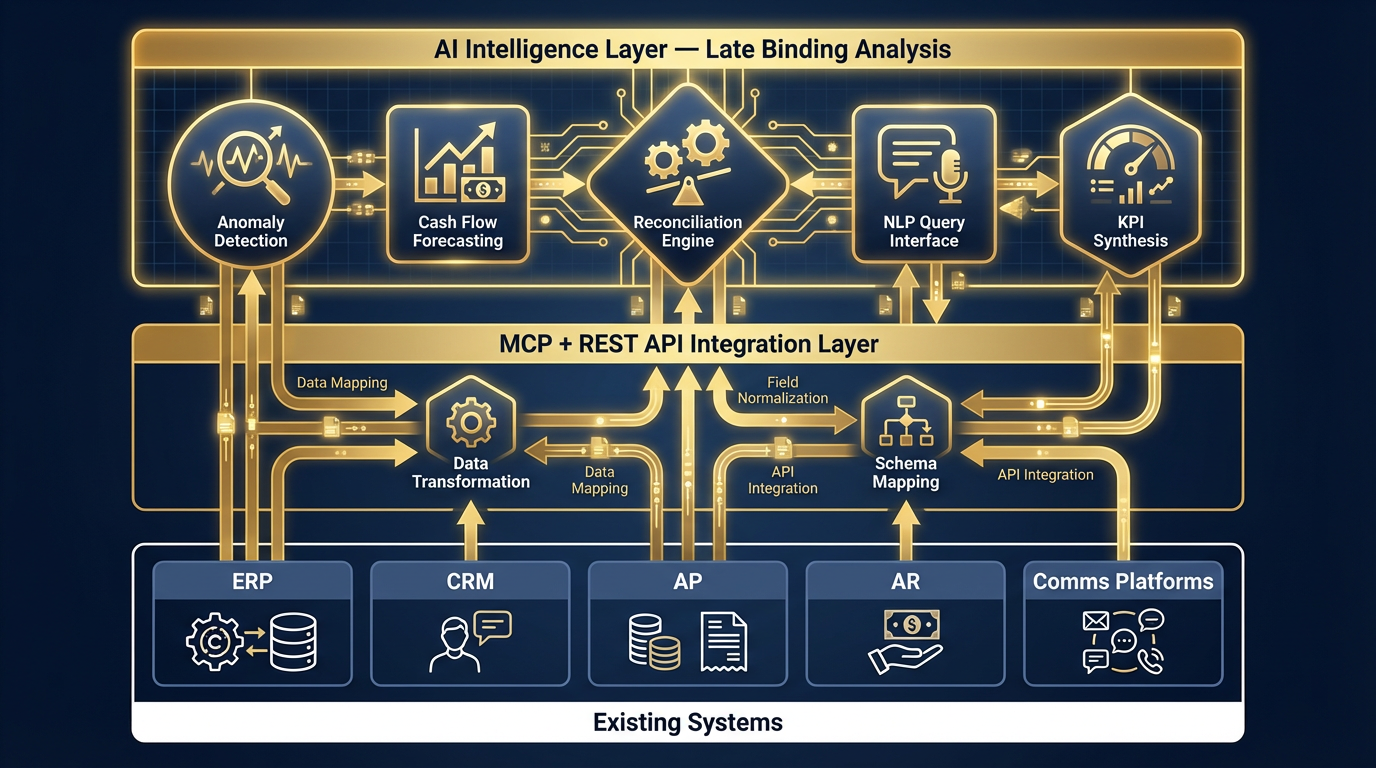
Three-tier architecture: Existing Systems → MCP/REST Integration → AI Intelligence Layer
The architectural decision that separates CortexStack from conventional finance automation: intelligence is applied after data is structured and normalized — not during ingestion. This late-binding approach allows the AI layer to reason across a complete, coherent data model rather than raw, heterogeneous system output.
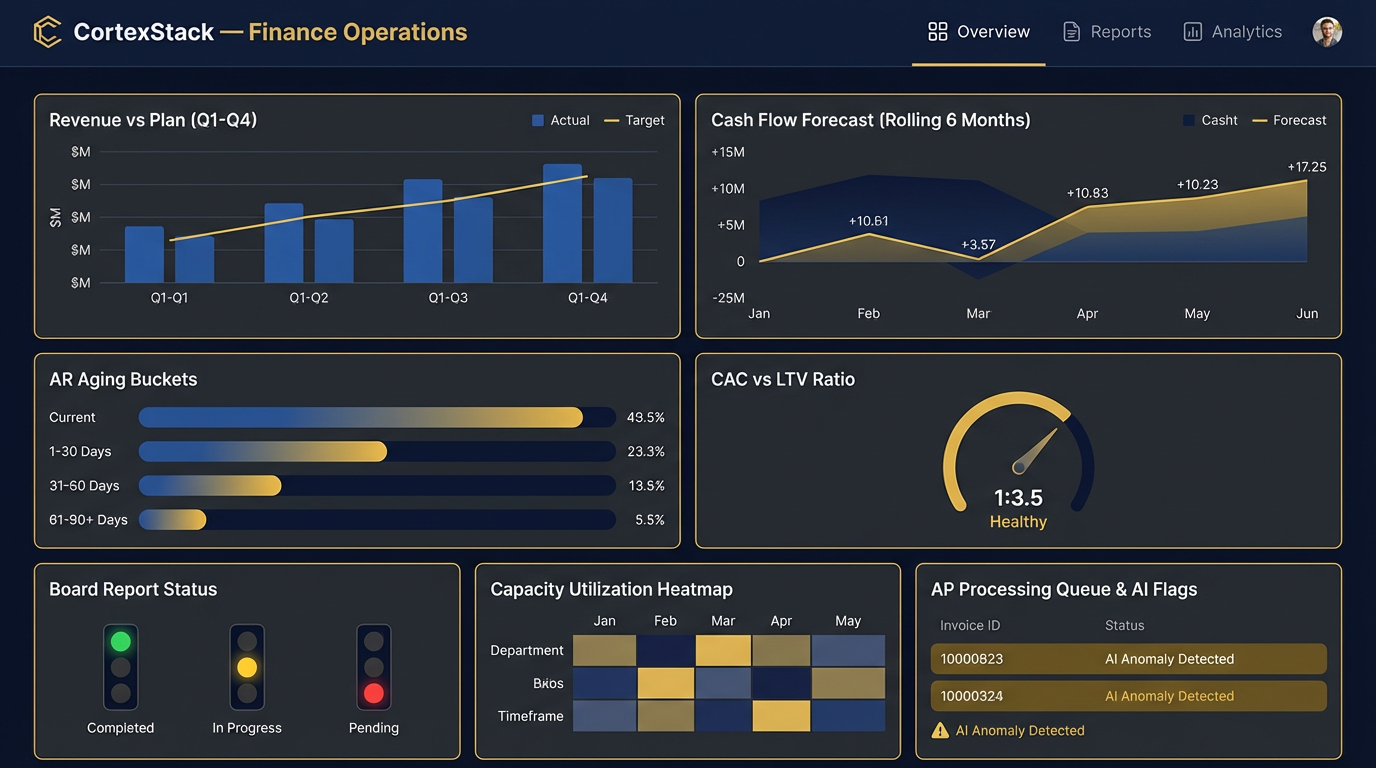
Unified finance command dashboard — real-time KPIs synthesized across all connected systems
Once the canonical data model is assembled, the intelligence layer applies a portfolio of reasoning functions that would be impossible against raw, siloed system data. The layer does not operate on any single system's output — it reasons across the full financial picture simultaneously.
CortexStack is not a monolithic platform. It is a portfolio of purpose-built instruments, each designed for a specific finance function. Tools are pre-built to standard and then configured per engagement — the integration layer adapts to existing systems, not the other way around.
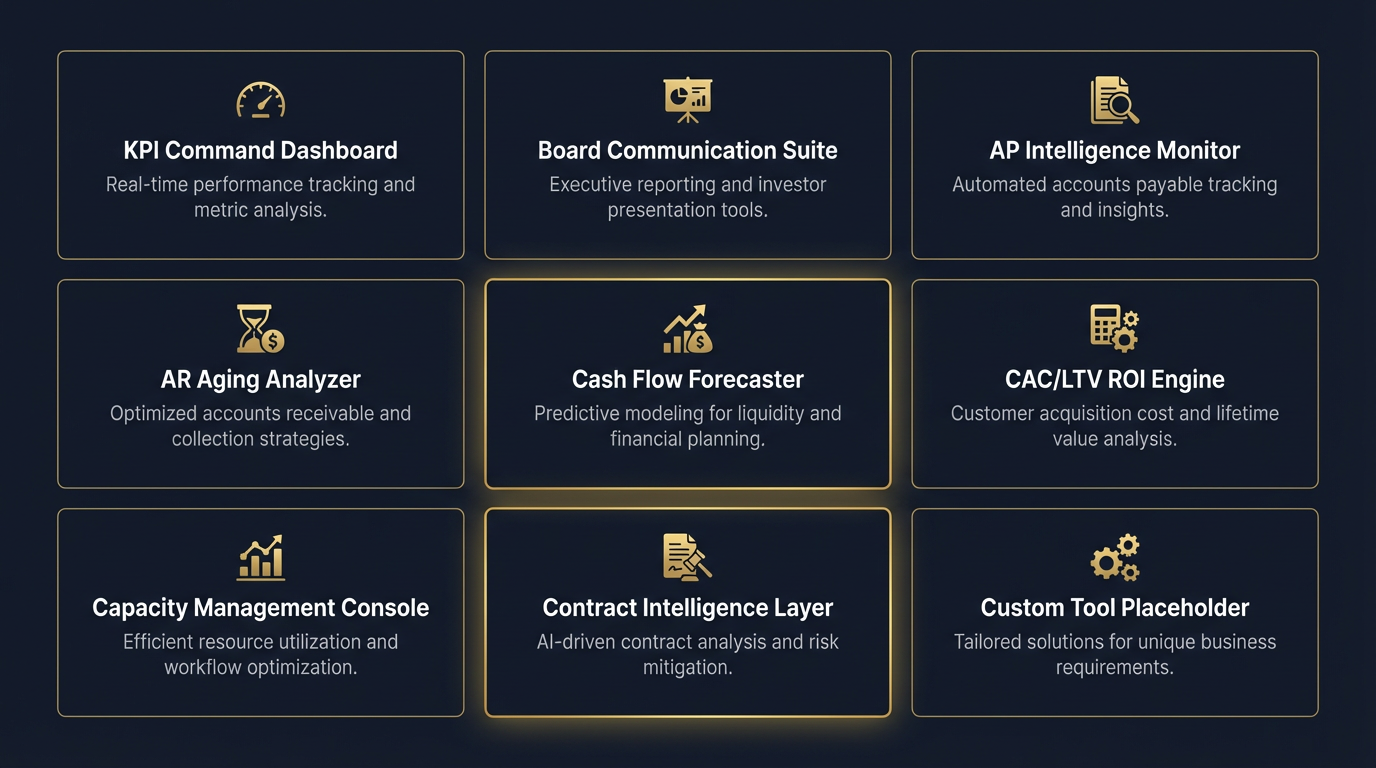
CortexStack tool portfolio — nine core instruments plus custom tooling by engagement scope
Real-time operational and financial KPI surface, assembled from all connected systems. Configurable hierarchies, period-over-period comparisons, and drill-down to source transaction. Board and management views.
Automated assembly of management packages — financial statements, KPI narratives, variance analysis, and forward guidance — generated from live data, formatted to institutional standards.
Full accounts payable workflow with anomaly detection, duplicate payment identification, vendor concentration analysis, and payment timing optimization against cash position.
Accounts receivable portfolio health across aging buckets, collection probability scoring, days-sales-outstanding trend analysis, and escalation workflow for at-risk receivables.
Rolling 13-week and 12-month cash position projections assembled from AR pipeline, AP commitments, payroll schedules, and contractual obligations — with scenario modeling.
Customer acquisition cost and lifetime value analysis synthesized from CRM, billing, and operational data. Unit economics by segment, channel, and cohort — built for both management and investor audiences.
Operational capacity modeling against revenue demand, staffing levels, and service delivery constraints. Identifies bottlenecks, forecasts utilization, and quantifies the financial impact of capacity decisions.
Structured extraction and monitoring of financial obligations across the contract portfolio — renewal dates, pricing terms, escalation clauses, and revenue recognition triggers surfaced automatically.
Cross-system reconciliation against the canonical data model, with exception identification, resolution queuing, and audit trail. Reduces close cycle time and manual reconciliation workload.
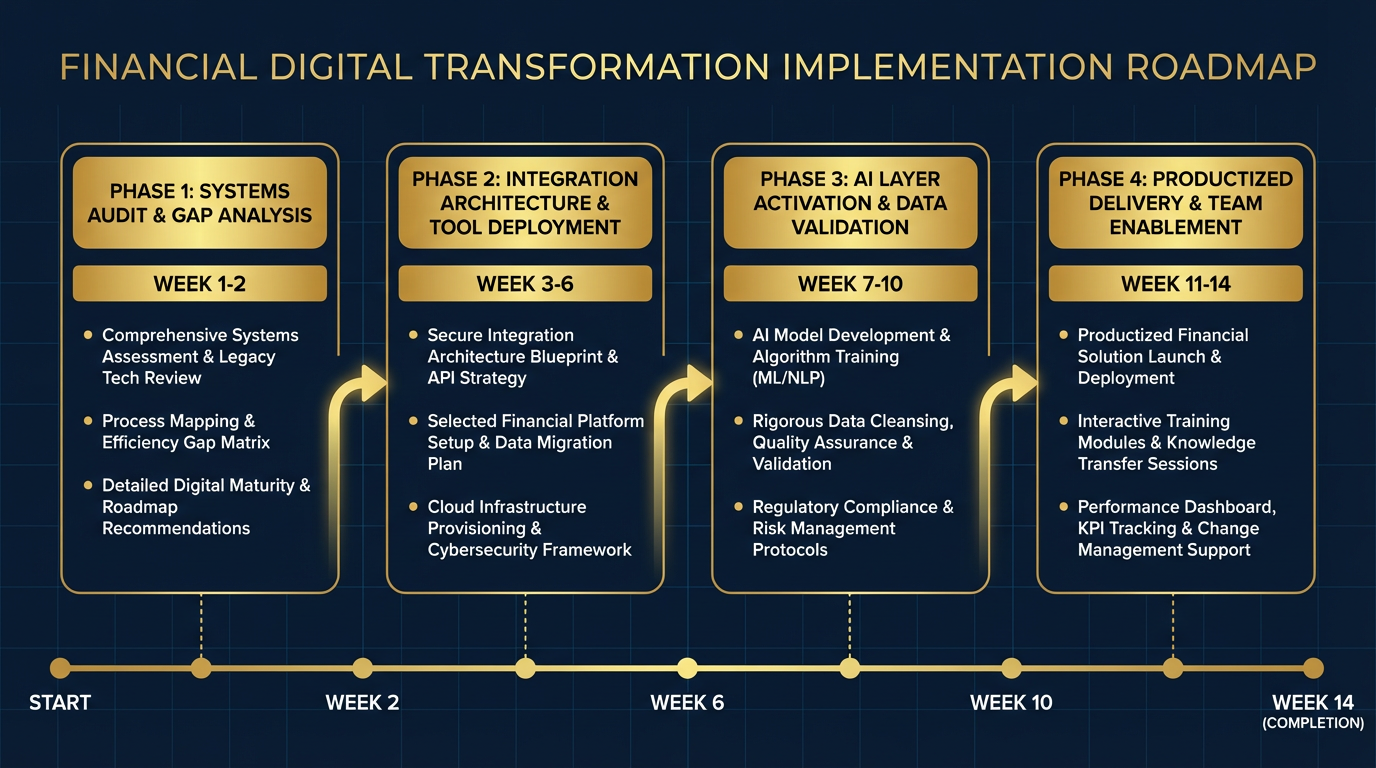
CortexStack engagements follow a defined implementation arc — from systems audit through live tool deployment and client enablement. The goal is not dependency: it is a fully self-operated, intelligence-enabled finance function.
Four-phase implementation: Systems Audit → Integration Architecture → AI Activation → Productized Delivery
Traditional advisory firms possess process knowledge. They do not possess the engineering capability to build pre-built integration adapters, architect a canonical data model across heterogeneous systems, or deploy a purpose-built AI intelligence layer calibrated to finance workflows. CortexStack is that capability — ready to engage.
CortexStack tools are not a project plan or a vendor recommendation. They are pre-built instruments with defined architectures, tested integration adapters, and productized output formats — ready to configure and deploy against an engagement's specific system constellation.
The engineering capability behind CortexStack spans API architecture, schema design, AI reasoning logic, and finance domain expertise simultaneously. This combination — advisory-grade domain knowledge plus production-grade engineering — does not exist at most advisory firms in any form.
The AI layer employs proprietary reasoning approaches calibrated to finance operations — not general-purpose language model inference. Late-binding analysis applied to a structured canonical data model produces outputs that off-the-shelf AI tools, applied to raw system exports, cannot replicate.
CortexStack is deployed through a Holding Advisory engagement — systems audit, integration architecture, tool configuration, and client enablement included. The result is a permanently elevated finance function your team operates independently.
Discuss an Engagement